
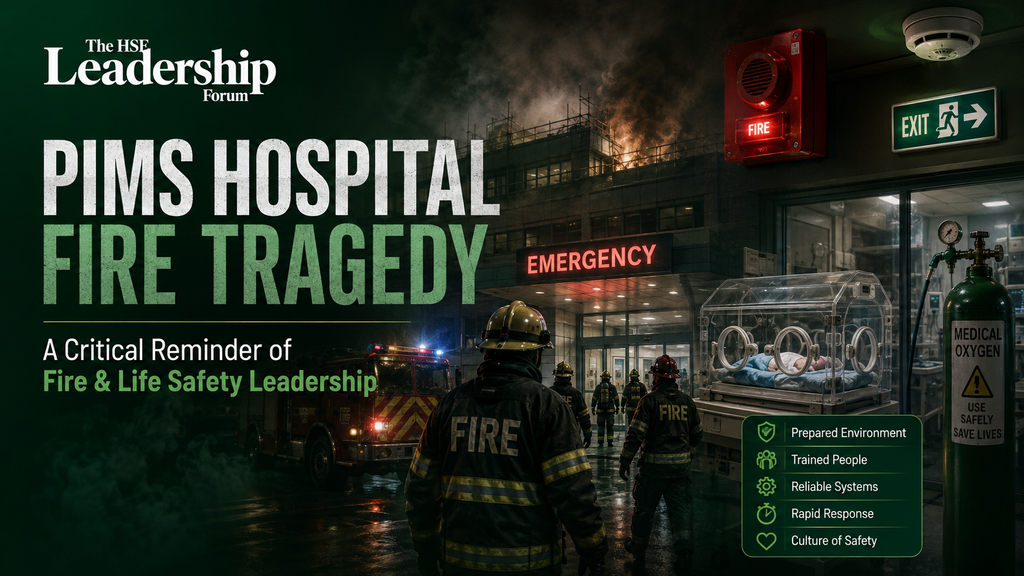
The reported deaths of 14 newborn babies following a fire in the maternity unit of the Pakistan Institute of Medical Sciences (PIMS) in Islamabad have brought renewed attention to the critical importance of fire and life-safety management in healthcare facilities.
According to reports, 15 newborns were present in the affected ward and one survived. The fire was reportedly associated with an air-conditioning unit and spread rapidly in an area where oxygen equipment was being used.
Pakistan’s Prime Minister Shehbaz Sharif has ordered an immediate investigation, while authorities have formed a fact-finding committee to establish the circumstances surrounding the incident, including the adequacy of fire-safety measures and the effectiveness of emergency response operations.
The reported suspension of the Federal Secretary of Health, Aslam Ghauri, further demonstrates the seriousness with which authorities are treating the incident.
However, before the investigation reaches its conclusions, it is important that the HSE community avoids speculation and instead focuses on the broader lessons that can help prevent similar tragedies.
Why Healthcare Fire Safety Requires Special Attention
Hospitals are fundamentally different from conventional workplaces.
Many occupants may be unable to evacuate independently because they are:
- Newborn or critically ill patients
- Physically immobile
- Connected to medical equipment
- Dependent on oxygen or life-support systems
- Unfamiliar with emergency procedures
In a neonatal unit, the challenge is even greater.
Newborn patients cannot self-evacuate.
Their survival during a fire emergency depends entirely on the effectiveness of the facility’s prevention, detection, containment, evacuation and emergency-response systems.
This makes healthcare fire safety a critical life-safety responsibility, not simply a regulatory or administrative requirement.
Oxygen-Rich Environments and Fire Risk
Reports indicate that oxygen connections were present in the affected area.
Oxygen itself is not a fuel, but an oxygen-enriched atmosphere can significantly increase the intensity and speed of combustion.
This highlights the importance of integrating medical oxygen systems into the facility’s overall fire-risk management program.
Healthcare organizations should ensure appropriate controls for:
- Medical oxygen storage and distribution
- Oxygen connections and fittings
- Leak prevention and detection
- Ignition-source control
- Electrical equipment
- HVAC systems
- Fire detection and alarm systems
- Emergency isolation arrangements
- Staff awareness and competency
The interaction between ignition sources, combustible materials and oxygen-enriched environments must be carefully assessed during fire-risk assessments.
Emergency Response: Preparedness Must Be Tested
A written emergency plan alone does not guarantee an effective response.
In a high-risk healthcare environment, emergency arrangements should clearly establish:
Who raises the alarm?
Who contacts emergency services?
Who takes command?
Who initiates patient evacuation?
How are neonatal patients moved?
Where are patients transferred?
How are staff, patients and visitors accounted for?
How will emergency responders gain immediate access?
These responsibilities should be understood by relevant personnel before an emergency occurs.
Regular drills and exercises should be used to identify weaknesses in communication, evacuation, access, staffing, equipment and emergency coordination.
Fire Prevention Begins Before the Fire
One of the most important lessons for HSE leaders is that emergency response should never be the first line of defence.
Prevention must come first.
Critical systems such as electrical installations, air-conditioning equipment, medical gas systems and fire-protection systems require effective inspection, testing and preventive maintenance.
A robust maintenance program should identify potential problems such as:
- Electrical deterioration
- Overheating
- Damaged cables
- Loose connections
- Equipment malfunction
- Improper modifications
- Poor housekeeping
- Obstructed ventilation
- Defective fire-protection systems
Preventive maintenance is an essential component of life-safety management.
Fire Doors, Access Control and Emergency Egress
Reports have also raised questions regarding access to the maternity ward.
The investigation will need to establish the actual circumstances surrounding access and egress.
From an HSE perspective, however, the principle is clear:
Security arrangements must never compromise emergency life safety.
Healthcare facilities require appropriate controls to protect vulnerable patients, but access-control arrangements must also support rapid emergency evacuation and immediate access for emergency responders.
Fire doors, escape routes, emergency exits and access-control systems should therefore be included in emergency planning, inspection and drills.
The Role of Fire Safety organizational Department.
Serious incidents often reveal weaknesses across multiple layers of an organization’s safety-management system.
Effective HSE leadership requires management to continuously ask:
- Are our fire risks adequately assessed?
- Are critical fire-safety systems functional?
- Are emergency exits accessible?
- Are fire doors maintained?
- Are alarms and detection systems tested?
- Are staff competent to respond?
- Are emergency drills realistic?
- Are maintenance findings closed promptly?
- Can vulnerable patients be evacuated safely?
- Have lessons from previous incidents been implemented?
These questions should be asked before an emergency—not after a tragedy.
From Compliance to Safety Assurance
A certificate, inspection record or completed checklist does not necessarily demonstrate that a facility is safe.
The real measure of safety is whether critical controls perform effectively when they are needed.
HSE leaders should therefore move beyond:
“Do we have a procedure?”
and ask:
“Does the procedure work?”
Beyond:
“Was the equipment inspected?”
ask:
“Was it functional?”
Beyond:
“Was training completed?”
ask:
“Can personnel perform effectively under emergency conditions?”
This is the difference between documented compliance and genuine safety assurance.
Lessons for Healthcare and Facility Management
The PIMS incident should encourage healthcare organizations and facility-management teams to review their critical life-safety arrangements.
Particular attention should be given to:
1. Fire Risk Assessment
Ensure fire risks are identified, evaluated and regularly reviewed.
2. Critical Equipment Maintenance
Maintain electrical, HVAC, medical gas and fire-protection systems through planned inspection and preventive maintenance.
3. Detection and Alarm
Verify that fire detection and alarm systems are operational and regularly tested.
4. Compartmentation
Ensure fire and smoke barriers, fire doors and protected routes remain effective.
5. Emergency Evacuation
Develop evacuation arrangements appropriate for patients who cannot evacuate independently.
6. Staff Competency
Provide practical training for fire response, evacuation and emergency communication.
7. Emergency Drills
Conduct realistic exercises and use findings to improve the emergency plan.
8. Management of Oxygen Systems
Ensure oxygen-related fire risks are properly understood and controlled.
9. Emergency Access
Ensure emergency responders can access critical areas without unnecessary delay.
10. Corrective Action
Track safety deficiencies to closure and verify that corrective actions are effective.
A Message for HSE Leaders
The loss of newborn lives is a devastating reminder of why fire and life safety must remain a leadership priority.
The objective of HSE management is not simply to respond effectively after an incident.
The objective is to establish sufficient layers of protection so that a foreseeable failure does not become a catastrophic event.
Effective safety leadership means:
Identify the risk. Control the risk. Test the controls. Learn from weaknesses. Improve continuously.
The PIMS tragedy should serve as a solemn reminder to healthcare organizations, facility managers, engineers, emergency planners, regulators and HSE professionals that fire safety is a shared responsibility and a critical element of organizational leadership.
While the official investigation must determine the precise causes and responsibilities associated with this incident, the wider HSE community can already reflect on one fundamental principle:
Every critical safety barrier must be designed, maintained, tested and verified before it is needed.
Because in a life-safety emergency, there may be no second opportunity to discover that a control was not working.
This article is based on publicly reported information regarding the PIMS hospital fire in Islamabad. The circumstances, causes and responsibilities remain subject to the official investigation. The HSE observations presented above are general professional lessons and should not be interpreted as findings of the investigation.